
Your Software Is About to Forget It Needs You
Every tool you use at work was designed around your limitations. AI is removing those limitations. The question is whether you'll be ready when the interface disappears.

I spent the last two weeks in two very different rooms and saw the same thing happen in both of them.
The first was an AI innovation workshop with a global brand. Seasoned enterprise employees, people who’ve spent a decade mastering complex internal systems and processes, suddenly realizing that the rules they’d built their expertise around were becoming optional. The second was a talk I gave at the University of South Carolina’s School of Mass Communications. Students about to enter the workforce who had no attachment to the old rules at all and were already building things their professors hadn’t imagined.
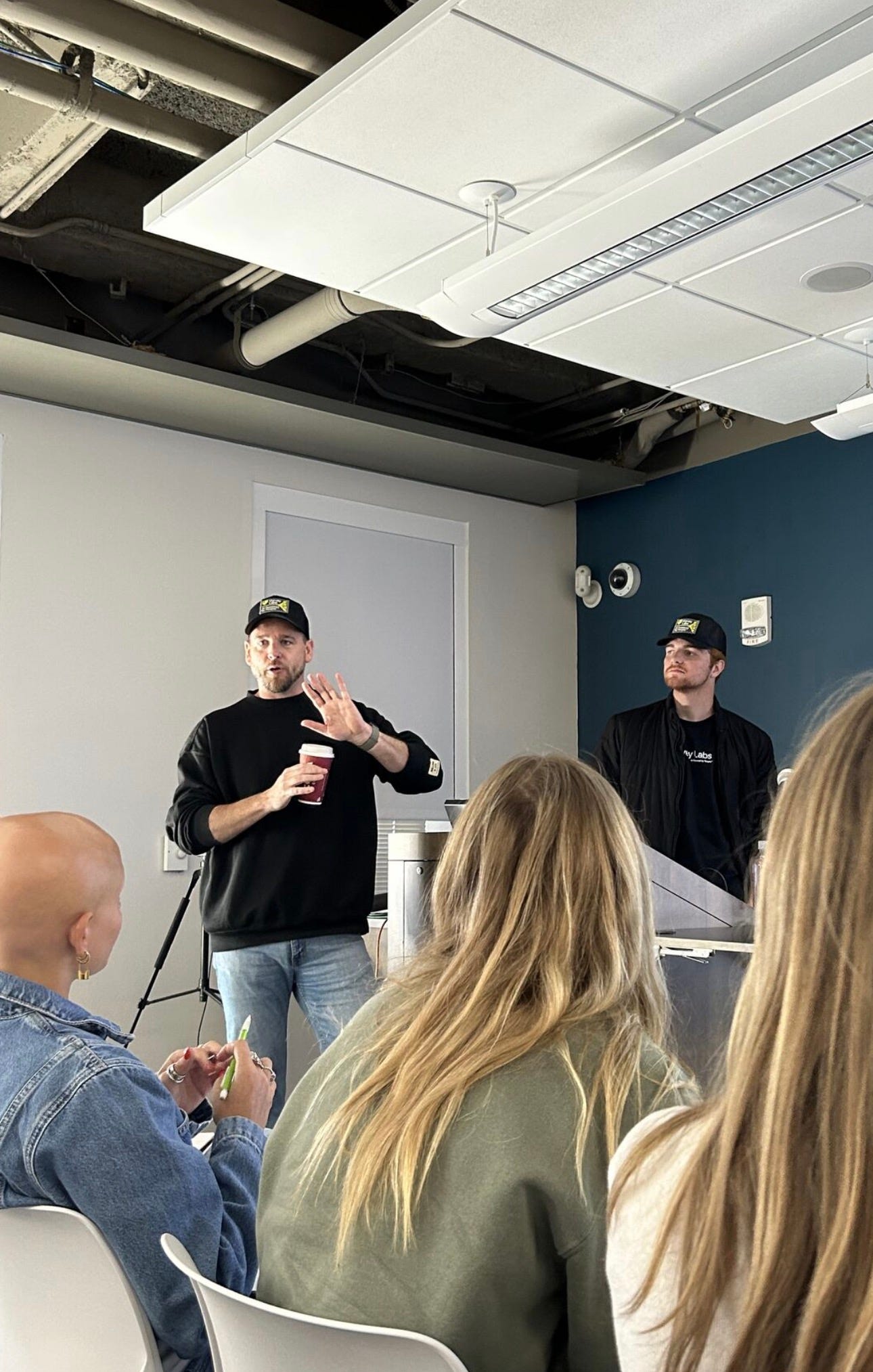
The dichotomy was striking. But the energy in both rooms was identical. The moment someone stopped thinking of themselves as a process follower and started thinking of themselves as a creative builder, something shifted. You could see it in their posture, in the questions they asked, in the way they leaned forward instead of crossing their arms. That shift is what excites me most about this work. My job sits in the middle of what is possible today and the expanding, rapidly changing world of what can be built for tomorrow, and I keep finding that the gap between those two things is smaller than most people assume.
Which brings me to something a VC posted last week that maps exactly what both of those rooms were reacting to.
Christoph Janz, managing partner at Point Nine Capital and one of the earliest investors in Zendesk, shared a table on X and LinkedIn titled “Every SaaS Feature, Reimagined.”
He’d been spending months building with Claude Code and OpenClaw, and arrived at a conclusion that should matter to every person who sits down at a computer for a living: every piece of SaaS hugely benefits from being infused with AI. The table he shared is the clearest map I’ve seen of what’s coming for the software you use every day.
But Janz buried the real punchline. He wrote that he was “only looking at the past, recent past, and near-term future here. Not even mentioning the mid/long-term, in which AI agents will do the majority of the actual work.”
Read that again. The majority of the actual work.
The enterprise employees in that workshop and the students in that lecture hall are heading into the same future, just from different starting points. What follows is what I think that future looks like, and what you can start doing about it now.
Every Feature You Learned Was a Workaround
Janz laid out ten core SaaS categories and showed what each looked like across three eras. Rule-based. AI-assisted. AI-native and agentic.
I want you to read this not as a product roadmap but as a map of what your daily work is about to look like.
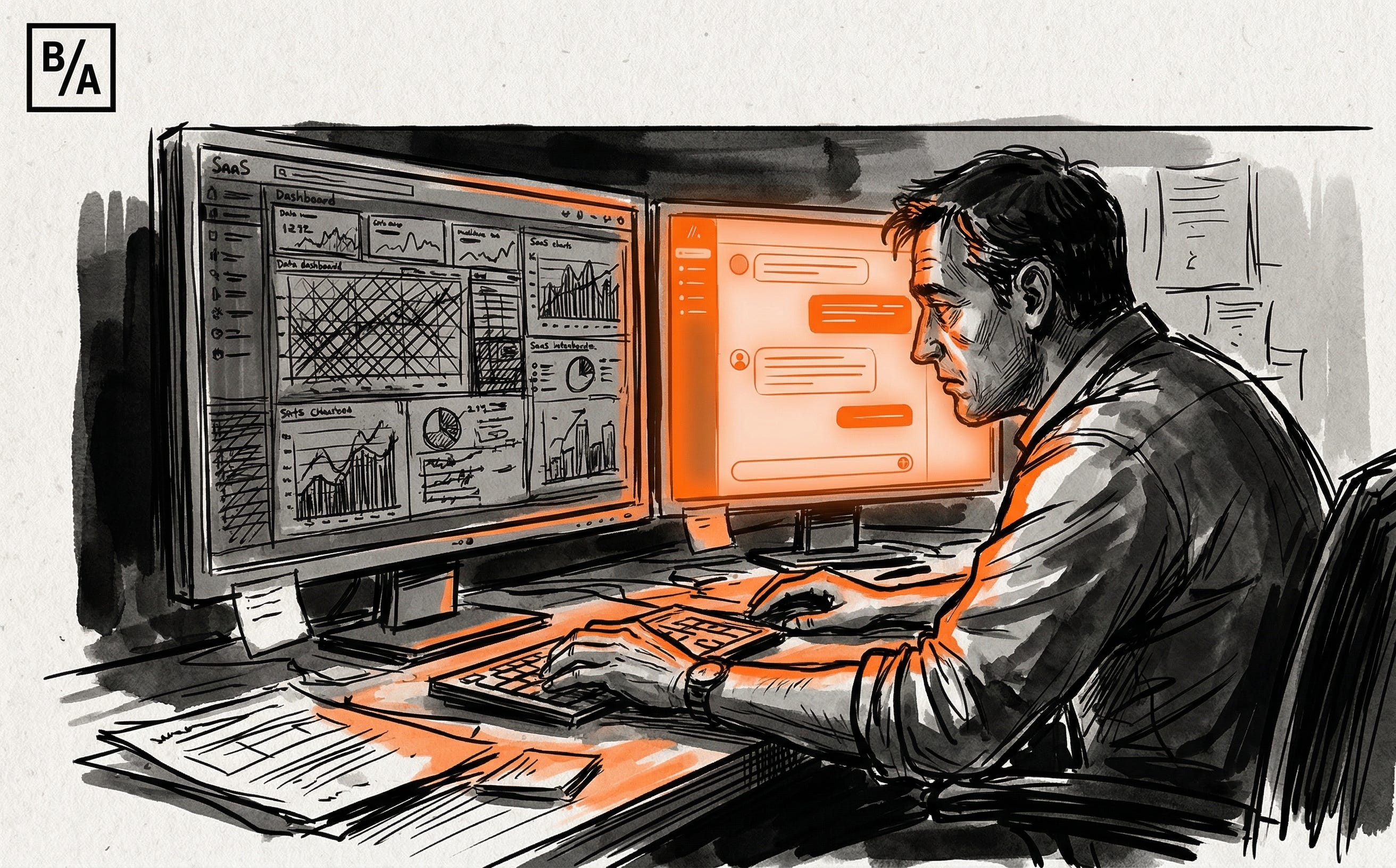
In the old world, you fill out 15 fields to create a CRM contact. In the new world, you say “I just met Anna from Siemens at a conference, she runs procurement, here’s her card” and the system creates the contact, enriches it, logs the interaction, and kicks off follow-up workflows. In the old world, you design a workflow step by step, and it breaks when an API changes. In the new world, you describe the outcome you want: “When a customer cancels, find out why, check the last 5 support tickets, pull their usage data, draft a churn analysis and send it to the account owner.” Agents handle the rest. In the old world, you write SQL queries or wait for someone in analytics to build you a dashboard. In the new world, you ask “What drove churn last month vs. same period last year?” and get an instant answer with generated visuals.
The pattern across all ten categories is identical. The software stops being something you operate and starts being something that operates on your behalf.
That might sound liberating. It should also make you deeply thoughtful about what happens next. Because every one of those old features, the 15-field forms, the manual workflow builders, the CSV imports, the keyword search, those weren’t just inconveniences. They were the work. And for a lot of people, knowing how to work those tools well is a meaningful part of their professional identity.
The Skill That Got You Here Won’t Get You There
I need to be honest about something I got wrong, and those two rooms helped me see it.
For most of last year, when I worked with enterprise teams on AI adoption, I kept telling them to focus on “AI-augmented workflows.” Find the bottleneck in your process. Add AI to that step. Measure the time saved. Get comfortable with the tools. The USC students didn’t need that advice. They were already past it. They weren’t trying to augment existing processes. They were asking why the processes existed at all. And watching the enterprise employees arrive at that same question, from the opposite direction, is what made me realize my earlier advice had been useful but incomplete.
That advice was useful and it helped people get started. But it missed the bigger picture entirely.
What Janz’s table made painfully clear to me is that the right question was never “which step of my workflow should I add AI to?” The right question, the one that matters for your career, is “which parts of my job exist only because the software couldn’t understand what I actually wanted?”
Think about it this way. Why did you learn how to build complex Excel formulas? Because the software couldn’t figure out what you needed from looking at the data. Why did you learn to navigate a CRM’s nested menus? Because the system couldn’t just listen to what you wanted to find. Why did you become the person who knows how to clean and import data from messy CSVs? Because the software couldn’t figure out the structure on its own.
Every one of those skills is a translation skill. You learned to translate your intent into a language that rigid software could process. And you got good at it. That’s not nothing, getting good at translating human intent into machine inputs is what made you valuable in a world of dumb tools.
But AI is making the tools smarter. And when the tool understands your intent directly, the translation layer, your translation layer, becomes less essential.
This isn’t a reason to panic. It’s a reason to redirect. Because the value doesn’t disappear. It moves.
Where the Value Moves
If AI handles the translation, what’s left for you?
Three things. And all three are worth more than the translation skills they replace.
The first is knowing what to ask for. When your reporting tool can answer any question in natural language, the person who asks “What drove churn last month vs. same period?” produces something useful. The person who asks “Show me the relationship between onboarding completion rate, first 30-day support ticket volume, and 6-month retention across our three highest-value customer segments” produces something that changes a business. The tool doesn’t know which question matters. You do. That’s judgment, and it’s the skill that appreciates most in a world of infinite analytical capacity.
The second is knowing what good looks like. When AI drafts a renewal proposal, a churn analysis, a customer communication, someone needs to know whether it’s right. Not just grammatically correct or factually accurate, but whether it fits this customer, this situation, this moment in the relationship. That’s taste. AI generates options. Humans with deep context select the right one.
The third is connecting dots across systems that don’t talk to each other. Even in Janz’s AI-native column, where agents access all your data across files, email, CRM, Slack, and calendar, someone has to understand how the pieces fit together. What does it mean that churn spiked the same quarter you changed your onboarding process and also lost two senior CSMs? AI can surface the correlation. A human who’s lived inside that business for three years understands the causation, and the politics, and the three things you tried before that didn’t work and why this time might be different.
Judgment. Taste. Contextual intelligence. These aren’t consolation prizes. They’re the skills that AI makes more valuable, not less, because now they operate at a scale that wasn’t possible when you were spending half your day filling in forms and building reports.
The Speed Matters More Than You Think
Here’s where urgency enters the picture. Gartner reports that less than 5% of enterprise applications had integrated task-specific AI agents in 2025. By the end of 2026, they project that number hits 40%. That’s an eightfold increase in under two years.
Gartner also predicts that over 40% of those agentic AI projects will be cancelled by the end of 2027 due to escalating costs, unclear business value, or inadequate risk controls. Both things can be true at once. The shift is real and massive. The execution is hard and many will fail. Welcome to the Both/And.
But even the failed projects change expectations. Once your leadership sees that a competitor’s team of 5 is producing the output of 20 because their tools work differently, the conversation about your tools and your team changes whether the implementation succeeds or not. TechCrunch is already calling it a “SaaSpocalypse” as AI-native startups redefine what it means to be a software company. The tools your company buys next year will look different from the tools you use today. That’s not speculation. That’s procurement reality.
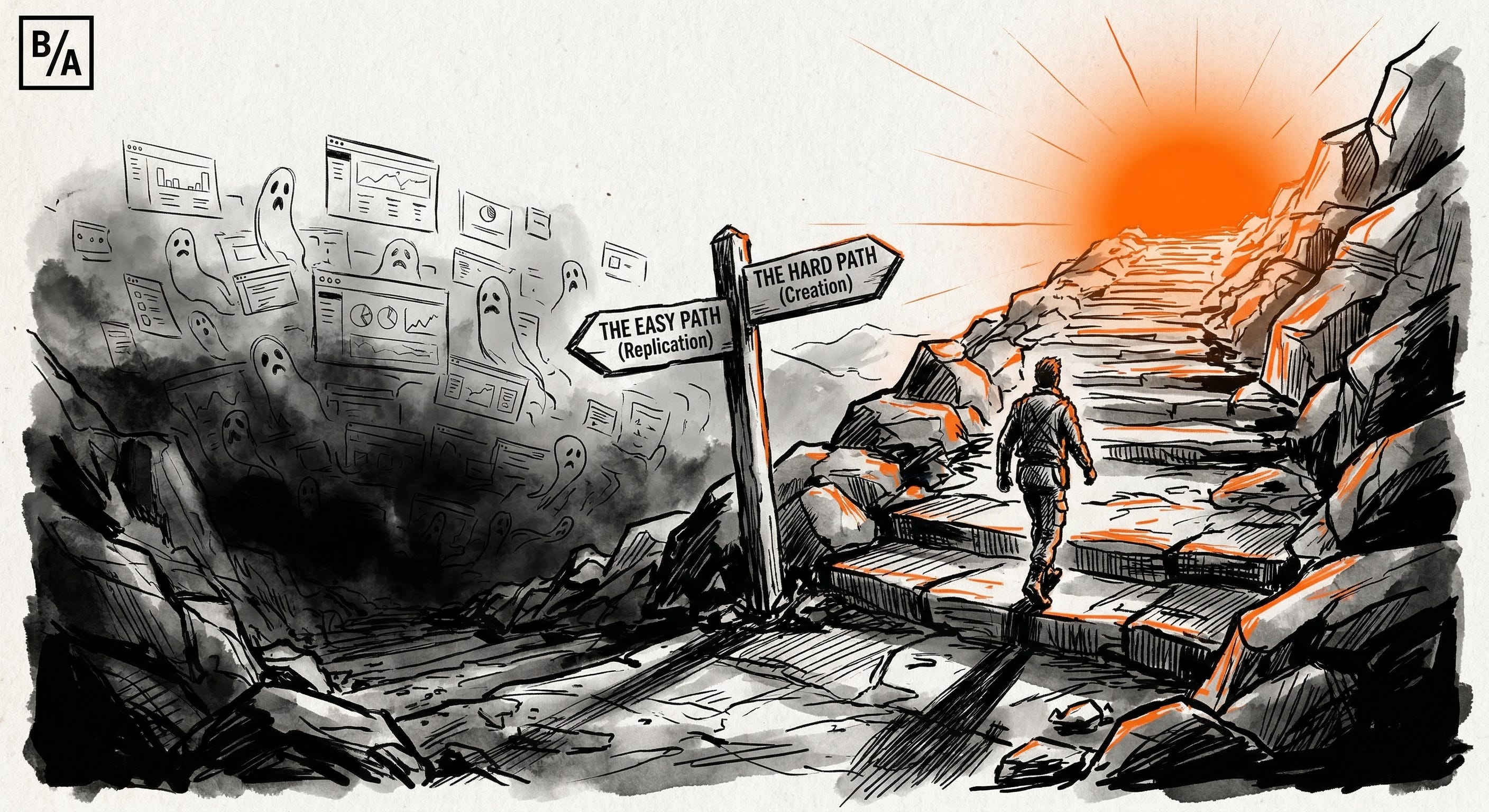
What this means practically: the software you’ve spent years mastering is going to change underneath you. Not all at once. Not everywhere simultaneously. But steadily, and in a direction that moves the value from “operating the tool” to “directing the outcome.”
What You Can Do Starting Monday
I’m going to be specific because vague career advice is useless when the ground is moving. And I want these to be different from the usual “learn to prompt better” advice, because this article isn’t about prompting. It’s about the disappearing translation layer between what you want and what your tools can do.
Map your translation labor. Spend one day this week tracking every moment you translate your intent into a format that software requires. Every time you fill in a form field, build a filter, write a formula, clean a CSV, configure a workflow, or manually move data from one tool to another, write it down. Don’t judge it. Just count it. Most people discover that 40-60% of their day is translation labor, work that exists because the tool couldn’t understand what they actually wanted. That number is the clearest measure of how much your daily work is about to change, and how much time you’re about to get back if you’re ready for it.
Describe outcomes to your tools instead of operating them. Pick one task you do every week that involves multiple steps across multiple tools. Instead of doing it the way you’ve always done it, write out what you actually want to happen as if you were explaining it to a new team member who’s brilliant but has never seen your systems before. “I need to know which of our top 20 accounts had a drop in engagement last quarter, why it happened based on support tickets and usage data, and a draft email to each account manager with the specifics.” Then give that description to Claude or ChatGPT and see what comes back. You’re training yourself to think in outcomes instead of procedures. That’s the shift Janz’s table describes, and the people who practice it now will have a massive head start when their tools start supporting it natively.
Build a “what would disappear” list for your role. Go through Janz’s ten categories (forms, workflows, data import, integrations, email, data access, search, reporting, document generation) and honestly assess which ones make up your daily work. Then ask yourself: if AI handled the translation in each of those categories, what would be left for me to do? The answer is your future job description. For some people, that list is long and exciting, full of judgment calls, relationship work, and strategic thinking that the tools just freed them up to do more of. For others, it’s short, and that’s important to know now rather than later. Either way, the clarity is the point.
Audit one workflow for “why does this step exist?” Most enterprise processes have accumulated steps over years that nobody questions anymore. Weekly reports that get built because someone needed them in 2019. Manual data reconciliation that exists because two systems were never properly integrated. Approval chains that were designed for a world where mistakes were expensive to catch. Pick one workflow you own and ask, for every step, “does this step exist because of a real business need, or because the software couldn’t handle it any other way?” The steps that exist because of software limitations are the ones AI will eliminate first. The steps that exist because of genuine business judgment are the ones that will matter more.
The Honest Part
I want to end with something I keep coming back to.
Janz is a VC who invests in SaaS companies for a living. And in February, he wrote a post called “AI Killed My SaaS” about replacing a complex software system he’d spent weeks building with Claude connected directly to his data sources. He got 90-95% of the value for about 10% of the effort. The person who writes checks for software companies replaced his own software. That should tell you something about the direction.
I’m not going to promise you that judgment and taste and contextual intelligence will be permanently safe from AI. I’ve watched “AI will never do X” predictions age badly enough times to know better. What I can tell you is that right now, today, the person who knows which question to ask is worth more than the person who knows which button to click. And every trend in Janz’s table, in Gartner’s data, in the software your company will be buying next year, widens that gap.
The translation layer between human intent and machine execution is dissolving. If your value lives in the translation, start moving it somewhere else. If your value already lives in judgment, direction, and the kind of pattern recognition you can only build by being deep inside a business for years, then what’s coming should excite you, because AI is about to hand you better tools for the thing you were already best at.
That’s what I saw in both rooms over the last two weeks. The enterprise employees who stopped defending their mastery of old tools and started asking “what could I build if I didn’t have to fight the software?” looked exactly like the students who never had to fight it in the first place. Both groups arrived at the same place. The ones who got there fastest weren’t the most technical. They were the most curious.
The software is about to forget it needs you to click the buttons. Make sure you’re the person it still needs to tell it what to do.
Your move.
This is part of the Both/And series, exploring how AI simultaneously replaces and augments workers depending on individual choices and implementation approaches. If this shifted your thinking, share it with someone on your team who’s still spending three hours a day inside dashboards. The ground under those dashboards is moving.